Go into any store today, and one thing may strike you as quite curious: it isn’t about the products alone anymore. It’s about lighting, layout, textures, and colors in harmony. Each and every shelf, every display, every digital screen seems to be telling something. All that harmony and atmosphere seldom happens by accident; most of the time, it starts as a digital vision brought to life through 3D rendering and store visualization design services.
Today, retail moves fast, and design is more than pretty-it’s strategic. It has taken until now for retailers to realize precisely how the layout and look of a store can actually influence the way people move and feel, and most importantly, buy. And that’s where 3D rendering services come in: giving designers and retailers the chance to see for themselves, test, and finesse their ideas before a single nail hits the wall.
3D rendering has now become the silent partner of creativity and decision-making today, be it a businessman, an interior designer, or an architect. It gives the edge to make those sketches and concepts leap to digital life. Be it bringing that vision into reality or not, Cad Crowd is where freelancers specializing in this field can be found. These professionals know not just how to make the store look good but also how to make it work.
So, let’s see how powerful technology has changed the modern retail landscape and possibly is one of the best investments your store design could make.
 Table of contents
The new reality of retail design
Retail used to be quite simple: pick the location, paint the walls, line up the product, and open the doors. That model was the result of a time when shopping was purely transactional. Today, shopping is an experience, a mix of physical and emotional engagement.
Gone are the days when a bit of shelving and some signage would suffice. They want atmosphere; they want to feel something when they come in. Be it the warm, rustic tones of a boutique coffee shop or the sleek minimalism of a tech store, design sets the stage to tell the story of the brand.
3D rendering allows that story to unfold before construction even starts. Advanced software now lets designers create ultra-realistic renderings of an entire space, including texture, lighting, and furniture placement. Want to know how a pendant light will cast shadows across a counter or if that red accent wall will make the space feel smaller or more inviting? The answer comes in an instant with 3D visualization services-no guesswork required.
This became especially helpful for store visualization design services, in which a client can virtually tour their future shop before committing to expensive physical changes. This has filled a gap between imagination and implementation because, suddenly, the ideas are no longer described but instead experienced.
Let’s be realistic here: moving a virtual wall on the screen is far easier than moving an actual plaster-and-paint wall.
RELATED: All you need to now about 3D visualization for architectural design and CGI projects
Why 3D Rendering Changes The Game
What really makes 3D rendering so transformative in retail design? The short answer is clarity, efficiency, and persuasion.
Clarity to all parties: Miscommunication is almost expected in a traditional design process, where a designer may have something in mind, and the client thinks of something completely different based on just a single 2D plan. The result is disappointment and delays.
With 3D rendering, everybody’s on the same page. The client doesn’t have to interpret a floor plan like an architect; they’re walking through a photo-realistic model of their store, saying things like “Yes, that feels right” or “Let us try something brighter.” It’s a collaboration made visual for AEC and CAD design companies.
Efficiency in design and construction: Mistakes are expensive in the real world but cost nothing in the virtual. Rendering allows designers to experiment with layouts, materials, and options for lighting before committing. Just think about finding out that a planned counter blocks the flow of customers virtually before it is actually built. That in itself can save weeks of rework and thousands in costs.
Indeed, the experts heading the 3D rendering process at Cad Crowd are specialists in their job; they know how to make such a process seamless. Undeniably, they will prove to be a worthy asset in refining each design concept for the teams with much more speed and little stress.
Stakeholder persuasion: If you have had to pitch a design to investors or a client, you understand how visual impact counts. That 3D render can make the concept real and achievable, boosting confidence in the project. It’s always easier to say yes to something that you are able to see and almost touch.
Many designers now use virtual reality integrations that enable the client to “walk” through their store with a VR headset. It’s one thing to view a 3D render on a screen; it’s quite another thing altogether to be standing inside of it.
RELATED: How various companies and industries embrace 3D rendering services and applications
From sketch to storefront: The design journey
This journey, from concept to completion, has used digital technologies wherever possible. CAD design experts in the past would draw concepts or even simple 2D plans. To make such drawings, a lot of imagination was required. The clients were supposed to imagine colors, textures, and proportions in their minds.
Today, 3D rendering replaces it all; everything from walls and shelves down to lighting fixtures and signage is done on digital modeling software. That would then be followed by the rendering phase, which includes adding realism through materials, lighting, and perspective. It’s just a detailed visualization-nothing more, nothing less-of how the finished store will be.
The renders serve to perfect everything from spatial flow to balance in lighting in store visualization design services. This is where designers can experiment freely: move a display, change the flooring, or even change the style of lighting. Every modification is visible instantaneously, thus enabling precise decision-making.
That flexibility has made 3D rendering a must-have for architects and interior design experts looking to push the creative envelope without increasing the risk. And the retailers love it too: They know just what they are getting for their money before construction even starts.
Cad Crowd is the technology, the craft that marries together the technical skill with the artistic flair for the freelancer into captivating visualizations, bringing with it a sense of confidence and excitement.
Smart stores: Where design meets intelligence
Design is not only about beauty; it’s about behavior. How customers move through a space can determine everything from how much they buy to how long they stay, even how they feel. Using 3D rendering, designers are able to study that movement in advance.
It helps designers predict the flow of traffic and congestion that may occur; it allows them to test whether attention is drawn to promotional displays or if pathways seem too narrow. Such studies lead to more intelligent and intuitive store layouts that invite customers to explore and interact.
This modern form of 3D rendering could encompass everything from the level of lighting to the type and placement of various products. Designers would test how natural light will interact with various surfaces or how a certain color palette will affect mood. It is the perfect mix of art and psychology, done digitally but felt physically.
It is this power of foresight that makes 3D rendering indispensable in today’s retail world, including product design companies.
Bringing lighting, materials, and branding to life
It doesn’t just happen when one walks into a store and gets that feel instantly. From the glow of the lights to the warmth in materials, down to textures under one’s fingertips, was all thought of. 3D rendering brings that precision into focus long before the actual store exists in physical form.
Take lighting, for instance: a designer can simulate every single bulb, every single spotlight, and every window via the digital model as one of the ways to test how that illumination is going to work with colors and surfaces. Whereas a clothing boutique would use warm lighting to accentuate texture and make fabrics more appealing, an electronics store could focus on cool, more focused lighting that evokes sleek modernity.
Previously, designers would have to use mood boards and their imagination, making educated guesses as to what such effects would be before the actual 3D rendering. They can now actually preview what each one of these lighting scenarios would look like, even adjusting for intensity and color temperature in real time. In such a way, they can experiment without causing any waste.
Material choices are another of the prime arenas that get transformed by rendering. Be it marble, wood, metal, or fabric, every surface differs under light. Immediately in 3D architectural visualization services, designers get to see those differences. Will a matte finish reduce glare? Will polished concrete make the space feel too cold? These become visible and answerable with precision, rather than theoretical questions.
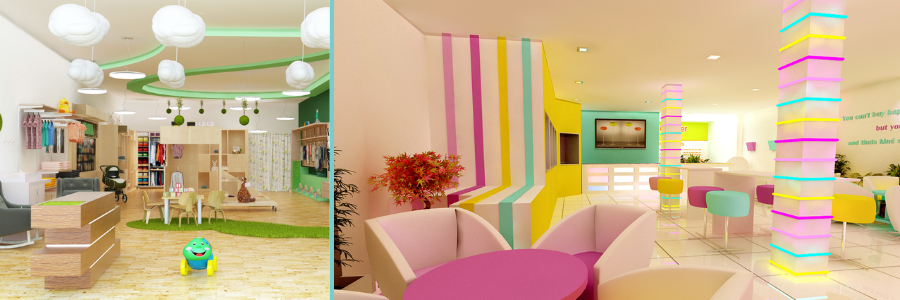
It’s the same with branding: the modern retail space needs to say something about a company’s identity, not only through signage but with the whole environment. The minimalist brand may revel in clean lines and neutral tones, while the playful one may favor bright colors and dynamic shapes. 3D rendering can let that be consistently expressed through design.
Below is the type of branded 3D visualization freelancers at Cad Crowd do: taking a set of guidelines for brands in retail and putting them into real-life design language. Instead of a flat concept board, retailers will get an immersive preview, which looks and feels like their future store.
Turning customer experience into a science
This retailer is selling an experience, not a product. Every single detail of that first step inside influences perception and behavior. 3D rendering turns those insights into a design strategy.
For example, better-lit display areas and intuitive flow paths attracted customers. A smart layout invites browsing while a poorly laid-out one hastens visits. Using 3D modeling, 3D modeling design experts can mock up how their customers will walk around them virtually. They can set focal points, adjust the width of the aisles, and even simulate crowd movements at peak hours.
Other advanced 3D visualization tools also incorporate behavioral data, so the designer will see if some height of shelving draws more attention or, perhaps, soft background lighting keeps people around longer. This isn’t too unlike running a virtual focus group where the “participants” are digital avatars responding to spatial cues. That kind of insight was all but impossible with conventional blueprints. Today, it’s part of the design toolset. And it saves both time and guesswork.
For example, a cosmetic shop may wish to attract the consumers’ attention to the new product lines but not ‘overwhelm the visitor’. The designer will play in 3D with display height, lighting angle, and color contrast until the perfect balance is struck. And that will look amazing, but perform just amazingly well.
From static designs to immersive experiences
3D visualization is by no means restricted to still images. Most store visualization design services will also include walkthrough animations, even VR experiences, that let people tour their ideas in a dynamic way. You don’t have to take a frozen snapshot of space; you can move through it, turn corners, zoom on textures, and even change your point of view as if you were there.
The value of this in the design approval stage is that walkthroughs will expose those little issues that might be hidden in static renderings, like awkward transitions from zone to zone or uneven lighting across product displays. This gives them ownership and confidence since they are not just imagining their store as a consumer product firm; they are experiencing it.
They are freelancers in 3D animation and VR design, and the overwhelming majority listed on Cad Crowd are brilliant at these interactive previews. They meld technical precision with flair for storytelling and turn the humble presentation into an immersive journey. When investors, stakeholders, or franchise managers can quite literally “walk through” a new concept, decisions are made more swiftly and with a lot more insight.
These retailers use the visualizations for marketing and training purposes, too, since the teams get to know the layout and design long before one store is actually built. Some companies go so far as to let their customers get an advance preview of a new location online in advance of opening. This builds anticipation and brand connection long before the first sale actually takes place.
RELATED: How 3D rendering enhances virtual furniture showrooms & shopping with company services
Savings through the power of visual precision
But setting creativity aside, the strongest reasons to adopt 3D rendering are pure economics: mistakes in retail design are expensive. Every wrong measurement, every misplaced fixture, and every ill-chosen finish adds up in terms of money and time.
3D commercial rendering services avoid costly surprises. It lets the designers visually test every single decision well in advance before it actually reaches the construction phase. The misplaced shelf that blocks the sightlines is moved in seconds, while the misjudged paint color gets swapped with one click. These early corrections are priceless when weighed against the costs of physical reworks.
Amazingly, small design mistakes are underestimated by retailers. Just imagine having to find out at the installation process that the display lighting doesn’t match up with the shelving below; correction may mean rewiring, adding extra fittings, or even reconstructing the ceiling. A 3D render would have shown that in a flash.
The freelancers at Cad Crowd offering 3D rendering services will always be ready to indicate those areas in a design that could be troublesome. Because of their experience, clients avoid possible pitfalls of poor or incomplete planning. Skilled visualization professionals can quite literally pay for themselves many times over.
Of course, it is not just a question of the money that might be saved, but also one of peace of mind. To eliminate all doubt and engender confidence, nothing works quite like being able to see your store before it exists. Everyone from the designer or builder down to the investors and sales teams will know precisely what to expect.
Cross-border cooperation
The beauty of modern technology is that it makes geography irrelevant: a retailer in London, if they wish, can work with a 3D rendering expert who might be based in Milan, New York, or Manila without any pain. High-resolution render files and real-time feedback tools make working remotely seamless.
This has opened up possibilities in Store Visualization Design by offering a pool of specialists across the globe-for example, retailers can hire specialists that may be in short supply in their home market. Perhaps one freelancer specializing in lighting simulation, another in realistic texturing, and yet another in VR integration can all provide together a holistic, world-class visualization solution.
This has been made easier with platforms like Cad Crowd. It connects clients with freelancers who have verified experience in architectural rendering, interior visualization, and retail design. A business can look through portfolios and check reviews from clients, then choose the best match for their requirements.
Besides being a splurge, the outsourcing of 3D rendering often makes sound operational sense for most firms because this approach reduces overhead and offers access to worldwide talent with fresh perspectives. Across cultures, designers develop sensitivity toward style and detail-the very things that can make a retail space stand out.
Designing sustainably with 3D rendering
Actually, today there are customers who do care about the issue of sustainability, and it would logically fall to retailers to feel the onus for reflecting those values in-store. Sustainability, from energy-efficient lighting down to using eco-friendly materials, is not just a design trend, but an expectation of the brand. The good thing is that 3D architectural rendering services make being ecologically responsible easier and smarter all at once.
Designers can specify what types of sustainable materials to use and energy-efficient layouts in advance through accurate digital renderings. Wonder how natural light might affect mood, hour by hour? One rendering can simulate the course of the sun. How will reclaimed wood look next to glass shelving? That combination can be tested in an instant, without ever cutting one piece of material.
That is the foresight needed in sustainable design. Sometimes this means having to experiment, and with each wrong decision in real life comes waste. The 3D renderings allow those experiments to be done virtually, so the final plan can be both eco-conscious and visually stunning.
Cad Crowd hosts freelancers who are pros in sustainable retail visualization. Professionals here know just how to balance environmental responsibility with aesthetic appeal. By engaging such freelancers, brands will be able to explore unique ways of reducing waste, using renewable materials, and making sure everything is energy-efficient without compromising on design quality.
3D rendering will help to effectively communicate the retailers’ ideas concerning sustainability. Imagine showing investors how natural ventilation is going to cut down energy consumption, or how the reclaimed materials will fit into the overall concept. It makes green thinking tangible, visual, and persuasive for architectural design firms.
Time and waste reduction in construction
All retail projects are necessarily a balance of speed, quality, and cost. Rarely do the three balance with traditional methods of construction. 3D rendering helps balance these three by reducing unnecessary revisions and miscommunications.
Once approved, the 3D design becomes a kind of visual roadmap for contractors, builders, and suppliers alike. What everybody’s work is supposed to look like at the end is crystal clear. There is no ambiguity concerning dimensions, materials, or finishes. This clarity translates directly into efficiency.
On-site mistakes are fewer because everything is already envisioned and checked. Construction teams waste fewer materials, suppliers deliver the right things, and project managers spend less time sorting out disagreements. All these factors combined create a smoother, faster build within budget.
This workflow works to the benefit of retailers and product development experts, too, even to the smallest boutique owners who cannot afford design delays. It can be even more efficient through Cad Crowd by hiring skilled freelancers; the services being provided guarantee highly detailed visualizations that act as common references for everyone on the team, whatever part of the world they may be in.
It’s a marriage of precision in design with practical execution that can see any retailer open its doors on time and within budget.
RELATED: How 3D real estate rendering services boosts traffic and visibility for realtors
Real-life stories
Probably the most convincing testimony to the power of 3D rendering, however, lies in the changes to real retail spaces. These visualization tools helped brands across industries take big ideas and create unforgettable environments.
Consider a designer fashion retailer who needs a complete makeover at the same time as making the customer feel exclusive, yet welcomed. A design team virtually tested through 3D rendering what different lighting temperatures would look like against silk and velvet. It was these virtual experiments that made them realize how slightly warmer lighting brings richer textures into space without overpowering it. The final design was acclaimed for its refined balance, achieved in great measure with digital visualization.
Other examples include a technology retailer whose products had to present themselves in display zones that are both visually appealing and without overloading the customer. With 3D rendering, 3D visualization designers can try multiple configurations and options regarding how traffic would flow. From adjusting shelving heights to playing with different floor finishes, even testing screen glare under artificial lighting, the final configuration moved customers smoothly from one product area to the next, increasing customer interaction and boosting sales.
Even much smaller independent retailers have benefited from this. One local bakery used 3D rendering to visualize a new store before it leased the space; its owners commissioned a freelancer from Cad Crowd for the task. It provided detailed renders that showed how rustic brick walls and soft pendant lights could make the place homely. When the shop opened, customers would say time and again that it looked “exactly like the pictures, “a testament to the power of clear visualization.
What all these stories show is this simple truth: when you really can visualize in 3D what you are going to build before you build it, you make better decisions. You save time, reduce risk, and build spaces that really resonate with customers.
How 3D rendering shapes brand experience
Retail design tells stories through space, and every nook, color, and surface has something to say about the values of a brand. 3D rendering fortifies this storytelling by allowing the designer to create every visual detail with intent.
Think flagship stores: aside from being retail outlets, they’re actually immersive brand experiences. Flagship stores express identity through lighting, in spatial flow, and through the use of materials. Well-executed 3D rendering helps the brand fine-tune such sensory elements long in advance of opening day.
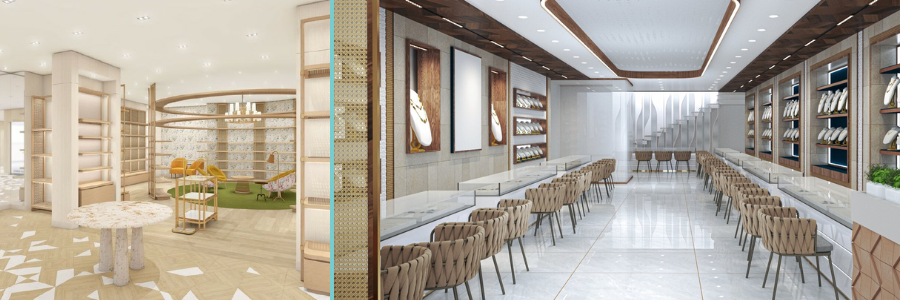
Consider a sportswear brand or fashion design company that wants to test how it brings motion and energy into its store design; it would 3D visualize the usage of curved walls, dynamic lighting, and bold textures. At the same time, a luxury jewelry brand would want to express softness, reflection, and intimacy. All these quite opposite moods require different visual languages, which can only be perfected with detailed visualization.
This even extends to signage, graphics, and digital displays. With this, designers make certain that the visibility of the brand’s message is consistent, whatever position it may take in the store. Finally, by integrating all these elements in one visualization, they create a cohesive storyline rather than disparate design decisions.
The freelancers offering store visualization services at Cad Crowd ensure they work closely with a brand strategist or marketing team, so aesthetic objectives align with business objectives, resulting in a final design that is beautiful yet yields measurable results in the form of footfall, engagement, and sales.
RELATED: How 3D animation helps deliver immersive marketing campaigns & company services
Wrapping it up
3D rendering completely reinvented the way retail spaces would be conceptualized, built, and experienced. It puts creativity and precision together in one robust design process with the inclusion of strategy. Want to see your retail dream come true? Start your journey now by finding expert freelancers through Cad Crowd, for the best 3D rendering for cutting-edge, immersive retail. And remember, readers, love imagery! Get a free quote today.
The post The Power of 3D Rendering in Modern Retail Spaces with Store Visualization Design Services first appeared on Cad Crowd.