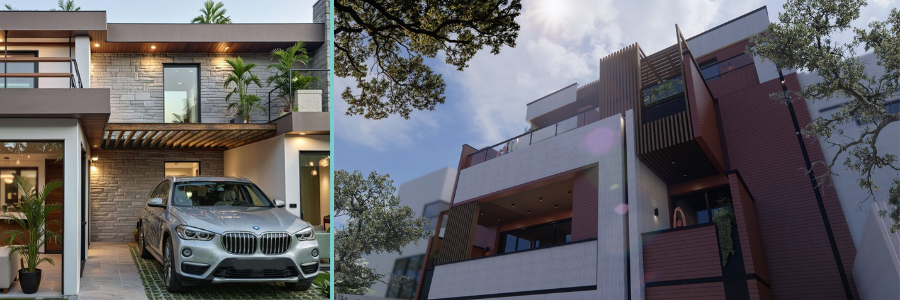
In a nutshell, a 3D architectural rendering is a lifelike visualization of a building or a project meant to depict the expected finished design before construction begins. If done by a skillful render artist, the visualization can be so realistic to the point where you might think you’re seeing a photograph instead of a computer-generated imagery (CGI). A high-quality 3D rendering may include not only the building itself, but also additional elements, including the surrounding landscape, along with lighting and shadows, as well as weather effects. Architectural visualization is often used as a presentation tool to give project owners and all stakeholders a clear, more understandable, immersive preview of the final product beyond what the blueprints and construction drafts can provide.
The term “computer-generated imagery” isn’t entirely accurate when used within the architectural rendering services context. While a lot of things you see in a realistic visualization are indeed computer–generated, it still takes a professional render artist to set everything right in the rendering software to produce lifelike imagery. Crucial aspects like compositions, viewing angle, proportions, and lighting must be configured with precision so that the resulting image turns out to be a faithful representation of the actual object. Cad Crowd helps you connect with the world’s most talented and experienced architectural render artists, offering an exceptional range of services from still visualization to animations and walkthroughs at affordable rates.
 Table of contents
An addition rather than a replacement
When you see a 3D rendering of a building, it’s easy to understand the spatial relationships between so many different elements. Whether it’s the distance from one wall to another, how a big glass window allows natural light to come inside, the flow path that connects the interior spaces, or the proportions of certain objects relative to the surrounding environment. Instead of seeing basic lines and shapes flooded with annotations, realistic visualization gives a glimpse into what it’s like to live in the building. And that makes a massive difference in the client’s ability to comprehend the design thinking of an architect (or designer) in charge of the project.
3D rendering makes sure nothing gets lost in translation. It transforms every design element, both simple and complex, into photo-realistic visualizations that even the most ignorant client can easily perceive and recognize. But this benefit often comes at the cost of an increased project budget. Bear in mind that 3D visualization services are not exactly replacements for 2D blueprints; they’re additions to the construction documents rather than alternatives.
Say you hire a construction company for a kitchen renovation, in which the scope of work includes the use of 3D renderings and animations to visualize the finished project. You should know that creating realistic visualizations is an optional service; irrespective of whether or not you commission the imagery in the first place, the company is still obligated to draft the traditional construction plans, mainly as a requirement for permit application and as the actual construction instruction for the general contractor. This means the 3D renderings and animations will increase the overall project cost.

RELATED: Relevance of MEP drafting services for architectural design firms & construction companies
Most construction companies already include the “drafting fee” in the initial estimate of a project. Lifelike visualizations add the expense of labor and specialized software. While it’s hard to pinpoint the exact cost of 3D renderings due to the bespoke nature of the construction project (even more so in residential buildings), the typical price range is as follows:
| Type | Notes | Price range |
| Basic renderings | A single still image of an exterior or interior with a low level of detail in Full HD resolution | $100 to $400 |
| Standard | Higher quality image with more polished details, including better lighting configurations and textures | $400 to $1500 |
| High-end | Visualization with extensive details for every object, and realistic lighting and shadows. Exterior rendering may include a visualization of the surrounding landscape | $5,000 or more |
| 360° Virtual Tours | An interactive visualization to provide an all-around overview of an entire building or space | $750 to $2,000 per space |
| Animations | The cost for an animated rendering is affected not only by the level of detail and video resolution, but also FPS rate and duration. | $2,000 to upwards of $10,000 per minute |
When incorporating 3D visualizations into a project workflow, you shouldn’t think of them as mere construction documents required to carry out the construction process. 3D renderings are additional tools that may effectively improve communication and identify mistakes early on in the design process; mistakes that potentially force the project to go way over budget.
RELATED: Full guide: Commercial architectural 3D rendering services for companies & firms
Impacts on the construction process
The general contractors probably prefer traditional 2D construction plans simply because the documents are easily copied and distributed to the builders, who use the drawings as instructions. Because a project often involves multiple workers to build different areas and spaces in a building, it’s easier to print a site-specific plan for each. As far as the actual construction process itself is concerned, 3D rendering and 3D animation services have minimal impact on how things are done.
But for the project as a whole, realistic visualizations do have direct and measurable impacts on design decisions and overall efficiency. Visual accuracy plays an important role. Lifelike rendering is an effective tool for architects, engineers, designers, general contractors, and clients to align their vision before the actual construction begins. It’s an instrument to facilitate design communication and check whether all the details conform to the original project brief.
The architects or designers ideally present the 3D renderings to all stakeholders before the construction process begins. In case somebody proposes a design modification, such as the addition or removal of certain details, everything can be verified through the visualization for approval. This is not to say that it’s impossible to implement the same approach using 2D drawings, but 3D visualization is a better tool to elicit feedback. Any major design decision is therefore made in accordance with stakeholders’ permission, opening the door to greater transparency. Construction starts only after the design is finalized and agreed upon by all parties involved. It reduces the likelihood of mid-project changes that may derail progress and add a significant financial burden.
Minimizing the possibility of mistakes is also about time efficiency. If all issues are identified and resolved during the planning phase, the project is more likely to adhere to the scheduled timeline. The construction process starts with an already clear roadmap, so there’s much less back-and-forth of RFI and fewer mishaps, if any. As a client, you also have better control over the budget.
It’s worth noting that 3D rendering and animation are not yet regarded as the core competency for a lot of construction companies. Although they are increasingly used in architectural projects nationwide, the 2D blueprints remain the standard option. Local building authorities also prefer 2D construction plans for adherence to code requirements. Because they’re not legally mandated, companies often choose to hire or outsource the 3D visualization task to external CAD design services, smaller design firms, or freelancers when a client commissions realistic renderings and animations. Instead of training an in-house professional, outsourcing is a smart strategic solution to cater to clients’ requests without adding overhead and losing the ability to maintain a full design team. Also, freelancers are known to be flexible professionals capable of providing cost-efficient rendering services based on what the project requires.
For clients and companies alike, embracing 3D visualizations is no longer a question of indulgence in pretty-looking imagery. The potential for cost-saving and time-efficiency in construction projects has turned it into an inevitable necessity. You can even say that 3D visualizations have revolutionized construction practices by promoting greater accuracy and project transparency. It also allows for easier and quicker design exploration without putting unnecessary risk of budget overrun. Yes, 3D rendering and animation add to the overall project cost, but all the benefits they offer can far outweigh the downside.

RELATED: How architectural CAD drawings help modern design and construction companies
Takeaway
You shouldn’t think of the 3D architectural renderings and animations as “contrasting” options to the traditional 2D construction plans. Photorealistic CGI-based visualizations are never intended to undermine the importance of conventional blueprints, but to enhance our understanding of architectural design in a much less technical way. The fact of the matter is that architectural drafts in their standard formats require a good deal of technical expertise to interpret; they’re too complex for most people to understand.
Architectural renderings, whether still imagery or animated, deliver the level of visual clarity that’s immediately accessible to everyone. Realistic visualization offers a vivid insight into the architectural design expert’s intent and bridges effective communication among all those involved in the project. It brings both the technical and non-technical people to the same page, fostering transparency in the design process, progress, and resource allocation.
But for 3D renderings to serve all those purposes, every single detail must be done with an uncompromising obsession with accuracy. The whole idea behind lifelike visualization is to create an imagery that represents everybody’s expectation of what the result shall be, not what might be. Many (if not most) construction companies these days still rely on 2D blueprints as the official construction documents for various reasons, including permit applications. But it doesn’t mean they can’t cater to a client’s request for realistic visualization in a project.
Cad Crowd is a specialized AEC-focused freelancing platform backed by hundreds of professional render artists experienced in both still imagery and animated visualization for projects of all sizes. With flexible pricing methods and rigorous quality assurance, it’s no wonder Cad Crowd has become the go-to platform for companies and clients to hire talented render artists. Get a free quote today.
The post How 3D Rendering and Animation Affect Construction Drawing Costs at CAD Services Firms first appeared on Cad Crowd.